
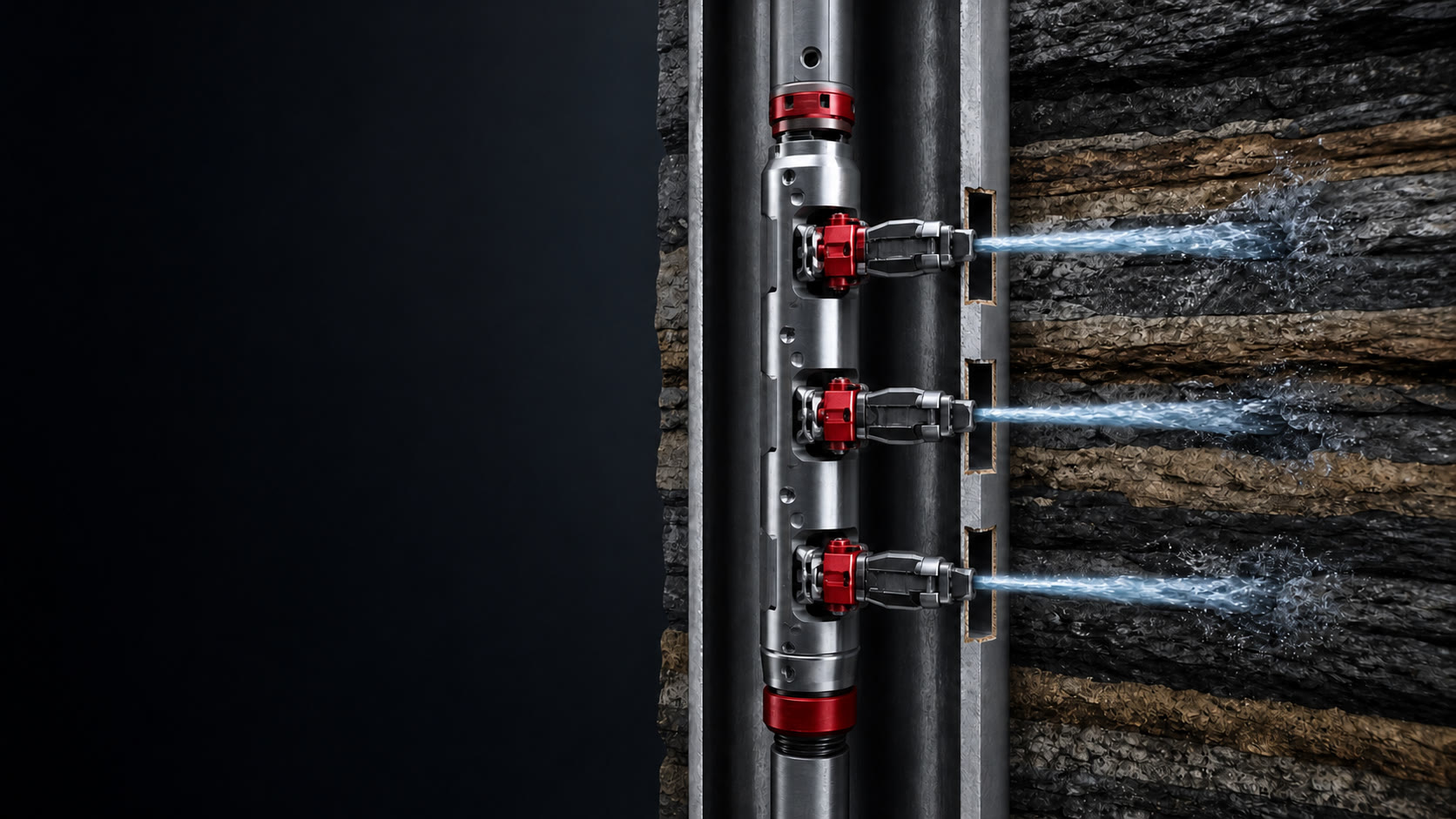
SOIMPRA provides hydromechanical perforating services to establish communication with the formation, support well interventions, and assist well abandonment programs. The process combines mechanical casing cutting with high-pressure fluid injection, without explosives.
Formation access without explosives.
The system cuts rectangular openings in the casing and directs high-pressure fluid jets into the formation. Hydraulic actuation allows the tool to perforate the casing and then circulate the well, reducing nonproductive time and operational risk.
Key applications.
- Establishing hydraulic communication between the wellbore and the formation.
- Well intervention, stimulation, and rehabilitation.
- Support for well abandonment and cementing programs.
- Remedial cementing and remediation of legacy environmental impacts.
- Deployment with a workover rig or coiled tubing, depending on the well design.
- Use in a range of well configurations and trajectories.
Operational and environmental benefits.
- Eliminates the need for explosives.
- Reduces operating costs and nonproductive time (NPT).
- Reduces risk during transportation, rig-up, and operation.
- Helps protect aquifers and environmentally sensitive areas.
- Allows assessment of options to reuse produced water or flowback.
- Provides an adaptable option for urban areas, active production sites, and locations with access restrictions.
How it works.
The tool combines filtration and circulation, mechanical casing cutting, and hydromechanical actuation. Pressure extends the cutters to create the openings; when pumping stops, the system retracts mechanically. High-pressure jets then act on the formation, and a final circulation stage cleans the well.
Additional operations.
After perforating, acid stimulation can be performed through the same tool. The tool can also accommodate memory gauges at its lower end to record pressure and temperature during operations that establish hydraulic communication. It can also be run with mechanical packers or abandonment plugs to streamline operations and reduce time and operating costs.
Planning each intervention.
Each operation is planned around the well design, its mechanical condition, and the intervention objective. SOIMPRA assesses the scope and coordinates the resources needed to deliver a safe, efficient technical solution.
TECHNICAL INFORMATIONFrequently Asked QuestionsReference information to explain how the system works. Final operating conditions are determined by the design and condition of each well.
What pressure and flow rate does the tool require?
The cutters begin to actuate at 700 psi. Cutting pressure depends on casing grade and condition; as a reference, operations in P-110 casing have been performed at 1,800 to 2,200 psi. Hydraulic perforating requires a pump capable of delivering up to 3,000 psi at 3 bbl/min, or approximately 126 gpm.
How is the tool run, and does it require a safety joint?
The available configuration is run on 2 7/8-inch tubing using a well-servicing or workover unit. It does not require a safety joint. Preparation and positioning are determined by the well geometry and conditions.
Is the casing perforated hydraulically or mechanically?
The cutters are hydraulically actuated, but they penetrate and open the casing mechanically. High-pressure jets then establish communication with the formation. No explosives are used.
What casing sizes and grades can the tool accommodate?
Configurations available in Argentina fit 5 1/2-inch and 7-inch casing and are compatible with grades including K-55, N-80, P-110, and Q-125. The broader tool range also includes sizes for 4-inch, 4 1/2-inch, 5-inch, 6 5/8-inch, and 7 5/8-inch casing, subject to availability and technical evaluation.
What maintenance does the tool require?
After each intervention, whenever operating schedules allow, the tool is fully disassembled at the service base for cleaning, lubrication, O-ring inspection, and reassembly.
How often are the cutters and jets replaced?
As a reference, the cutters are replaced after 450 to 500 perforating cycles, although the interval may vary with the casing grades involved. The jets are integrated into the cutters and are replaced with them.
How is the risk of the tool becoming stuck reduced?
The design is intended to minimize this risk. Wellbore clearance is checked before the intervention. A slight upward movement of the tubing allows the cutters to retract into the tool body to aid retrieval.
How large are the openings made by the cutters?
The same cutters are used in the 5 1/2-inch and 7-inch casing configurations. Each actuation creates two openings measuring 40 × 19 mm. According to the supplied technical data, the open area is approximately 7.2 square inches per meter, compared with approximately 3.78 square inches for conventional explosive perforating.
How are the number and spacing of openings determined?
This system does not fire shots and is not specified in shots per foot. Each actuation creates two openings. As an operating reference, the tool is typically actuated at 30 cm intervals. The number of openings per meter can be adjusted to the client's program and objectives.
How far can stimulation extend into the formation?
Cavity penetration depends on injection time and formation hardness. Reference operating periods range from 5 to 20 minutes, with reported penetration of approximately 14 to 59 inches. The reference range for conventional explosive perforating is approximately 12 to 36 inches.
What fluids can actuate the tool, and does the well need a standing fluid level?
No standing fluid level is required. The rig pump fills the tool by pumping directly down the tubing. It can be actuated with fresh water, brine, diesel, or crude oil. Acid stimulation can also be performed through the same tool after perforating.
How many tools are run, and how many perforating cycles can be completed?
One tool is run per well. Its configuration allows up to 500 consecutive perforating cycles, subject to operating conditions and a technical assessment of the intervention.
What are the tool's mechanical ratings?
The supplied technical specification lists a tensile capacity of 68,000 lb and a collapse pressure of 10,000 psi. These ratings must be considered alongside the well design, mechanical condition, and operating program.